
Introduction
A washing machine is one of the most useful household appliances in modern times. It provides much convenience in cleaning clothes because one can simply load a washing machine, pour the detergent in, and choose a cycle to complete the process.
However, as any other household appliance, a washing machine can face certain problems over time. These problems include sudden failures to operate and gradually developing issues, such as strange noises, ineffective drainage, shaking, and inability of the machine to clean clothes properly. Although it may be frustrating, a number of problems that washers experience are quite simple to diagnose and resolve on one’s own.
Knowledge about the possible reasons behind a particular problem can help to save money and avoid additional costs. For example, a washer fails to drain because of the plugged drain hose. Moreover, too much shaking may be associated with an unbalanced load or a poorly leveled floor. Likewise, failure to fill with water may be caused by the closed water supply or a clogged inlet filter. Many of these problems may occur because of regular lack of maintenance and cleaning of the appliance.
It is important to disconnect a washing machine before starting to fix anything to ensure safety. Besides, some problems require the intervention of specialists because they involve electrical components, wiring, motors, and other mechanical parts of the washer. This guide will present some of the most common problems experienced by washing machines and their easy solutions to help homeowners cope with them safely and efficiently.
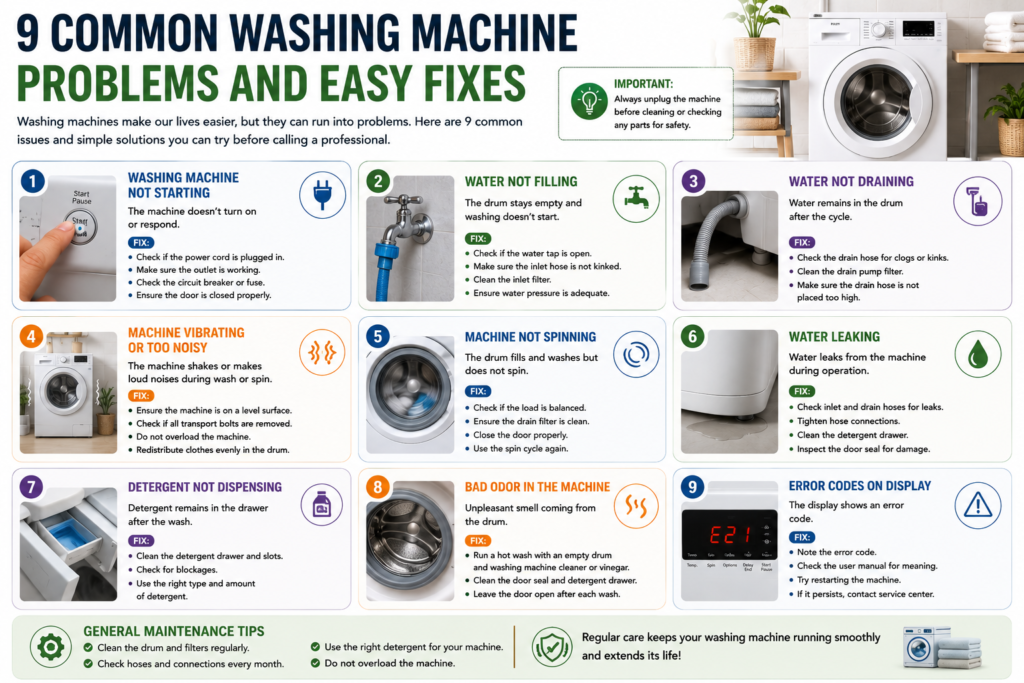
Machine Won’t Start
When a washing machine does not start working, it can be really frustrating if you already have some laundry to wash. Yet, it is unlikely that the appliance is faulty; there is a probability that the machine won’t start due to the reasons related to its power supply, door, settings, and water connections. First of all, it is recommended to check the presence of power supply in your machine. It is important to make sure that the plug is plugged into the electrical outlet and that the outlet is working. You can try to check it using another appliance. You should also make sure that the plug is connected to the switch and the switch itself is switched on.
Another possible cause of the failure to start working is the position of the door. Most modern washing machines have safety locks that do not allow to start a cycle if the door of the machine is opened. Therefore, one should close the door, making sure that there is no clothing trapped between the door and the rubber seal. Also, it is possible to check the child lock feature of the machine.
It is important to check the selected washing program and make sure that the Start or Pause buttons were pressed. One should also understand that sometimes the washing process starts several seconds after the Start button was pressed. It is also recommended to check the display of your machine: if there is an error code on the display, you need to check the owner’s manual.
You should also check the water supply. Make sure that the tap supplying water to your washing machine is open, and that the inlet hose is not kinked.
In case you have checked these causes and your washing machine still does not react to any of your actions, do not force the controls and open your machine. It is possible that there is a problem with such machine parts as door lock system, control board, motor, and other machine components.
Not Draining
A washing machine that will not drain properly is a common malfunction that can leave your clothes soaked at the end of the washing cycle. In some cases, the machine may even fail to complete the spin cycle due to its inability to remove the water from the drum. Luckily, a washing machine problem with draining is usually repaired by checking a few of the most common areas for faults and has a simple solution. Before inspecting any parts, remember to turn off and unplug the washing machine for your own safety and according to the owner’s manual. If there is a possibility of encountering water, it is important to ensure that there are no large amounts of it in the drum, as you will likely have to take some measures to get rid of it.
The first thing to check is the drain hose. Firstly, ensure that it is not bent, twisted, crushed, or obstructed in any other way. Furthermore, make sure that the hose is not clogged anywhere near where it connects to the drain of the house, as this could also be the reason that the washing machine is not draining properly. If it is a washing machine that has a drain or a pump filter that can be removed, it would be useful to check the owner’s manual for the exact procedure for removing and inspecting the drain. Sometimes, small foreign objects such as coins, pieces of clothing, hair, lint, or even buttons can get caught in the drain and block it. It is important to clean it of any dirt and take measures to avoid getting electric shocks while working on the washing machine, so it may be helpful to have a bucket or a towel nearby to get rid of the water.
The other frequent issue is that the washing machine is overloaded, which can cause it to malfunction. It is necessary to reduce the amount of clothes in the drum to a reasonable amount so that the washing machine can complete the spin cycle. If there is an option, it may also be a good idea to use the drain option or a spin cycle, again, according to the owner’s manual. Finally, using too much detergent can cause extra suds, which may interfere with the normal functioning of some washing machines.
If none of these solutions work, the issue may be in the drain pump or another part of the washing machine. In such a case, it is best to contact a professional and ask them to look over the machine and find the source of the problem. It is best to attempt to resolve washing machine draining issues as soon as possible as they can lead to unpleasant smells, water damage, and put extra strain on the appliance.
Excessive Vibration
Excessive vibration is one of the common issues with the washing machine that usually occurs during the spinning cycle. The device vibrates slightly, which is normal, but if the shaking is too strong, accompanied by the banging or moving of the washing machine across the floor, this means that you should pay attention to it. The first reason why the device may vibrate is an unbalanced load. The clothes gather inside the drum, which creates the imbalance. Thus, the device starts shaking during the spinning of the drum. You can face this situation when you wash only one heavy thing like a blanket or a big towel, or several kinds of clothes became entangled. In this case, you should stop the cycle and redistribute clothes inside the drum evenly.
Another important thing that affects the vibration is the position of the washing machine. It should be on the firm and flat surface. If the floor is uneven or the adjustable foot of the machine is not properly set up, the washer can start rocking. You can test it by pushing the machine in various directions – if it does, you should adjust the leveling feet. Do not place the machine on an unsteady surface or use some objects under the feet.
In the case with the newly installed washing machine, one more thing that you need to pay attention to is the shipping or transit bolts. The purpose of those is to fix the drum while transporting, and they should normally be taken off before the using. If the bolts are present, the machine will vibrate very heavily and may even break down. Follow the instructions for your specific model.
And one more thing to consider is overloading. The excess of weight may cause the difficulties with balancing and put extra strain on the drum, the motor, and other machine parts. In case if the machine continues to vibrate heavily, although the load is properly balanced and the machine is placed correctly, there may be some problem with the suspension system, bearings, or some internal part of the machine. You can stop the use of the machine in this case and call the technician.
Bad Odor
There is no doubt that a dreaded washing machine smell can arise, especially when it is used but not cleaned often enough. Soap, fabric softener, lint, hair, dirt, and dampness can remain in the washing machine’s drum, around the rubber door seal, in the detergent dispenser, drain, and other places. This accumulation can lead to the growth of odor-causing bacteria and mold in the washing machine. Moreover, it might make your clothes smell unpleasant after being freshly washed and dried. Luckily, there are several ways to get rid of the smell in the washing machine.
To begin with, if you own a front-loader washing machine, you should first check the rubber door seal. Open the door and examine the folds for any accumulation of hair, lint, foreign objects, or water.
Make sure to wipe it with a damp towel or cloth. Also, remove the detergent dispenser and clean it since soap and fabric softener residues sticking to its walls and bottom can also contribute to the foul smell. Next, you can use a special washing machine cleaning tablet as instructed in your owner’s manual or run a cleaning cycle, if your washing machine has this feature. You should also try to leave the washing machine door open as much as possible to help it dry after each use. Still, you should ensure that the appliance is inaccessible to children and pets in the house.
Furthermore, it is essential to avoid overloading the washer and using excessive amounts of soap or fabric softener. Doing so might cause suds, which will make your laundry look dirty, and leave residues on the clothes and the washing machine itself. Finally, always remember to take the wet clothes out of the machine right after it finishes washing. Leaving wet or damp clothes in the washer for a prolonged period will cause the unpleasant odor.
However, if the described above washing machine cleaning methods have not resolved the issue, you can try to check the drain hose and washing machine filter. They might be clogged with dirt or debris. Besides, a lingering odor might be caused by a more severe malfunction in the washing machine. Therefore, if you have tried everything and the odor is still present, you should consult a professional washing machine repair service.
Water Leakage
A water leakage is an important issue when it comes to the washing machine as even minor leaks can result in damage to floors, walls, cabinets, or other surroundings. A leaky washing machine can have multiple reasons, some of which are easy to detect and fix. It is necessary to turn off the device and disconnect it from the electrical outlet if you can do it safely. If there is a lot of water around the machine, it is necessary to take care of it before you begin inspection. Finding the reason for the leak is the first step in fixing the problem.
Probably one of the most frequent reasons of the water leakage is a damaged or loose water supply hose. It is necessary to make sure that there are no problems with the connection of the hose behind the washer and at the point where the hose attaches to the water supply in your household. The connection should be tight, but you should not overtighten it since it can damage the fitting or seal. You need to examine the hose for cracks, holes, bulges, and wear. A damaged hose should be changed in almost all cases. You also should examine the drain hose, which can be loose, blocked, or improperly installed resulting in water leakage during draining.
When it comes to front-loading washing machines, you also need to check the rubber door gasket. It can be loosened by small objects, dirt, hair, and its damaged parts. Cleaning the gasket and looking for cracks or tears is necessary in this case. In addition, you should make sure that you do not use too much detergent, which causes an overflow or a leakage due to excessive suds. You should always follow the recommendations of the manufacturer regarding the detergent usage.
In the case when water is leaking under your washing machine, you should pay attention to the drain pump, internal hose, the tub, or another inaccessible part of the machine. It is not wise to dismantle the machine if you do not have enough knowledge about it and if the manufacturer does not allow you to do this.
When to Call a Professional
Most of the frequent washing machine malfunctions can be solved by an average household owner by performing a set of simple actions like clearing the filter, unblocking the pump, redistributing the laundry, checking the inlet, or ensuring the door is fully closed. However, one should not attempt to fix some issues on their own as it may result in expensive repairs and irreversible damage. It is essential to understand when it is time to call a professional to address the problem and restore the proper functionality of the washing machine. For example, if the described above methods did not work, and the appliance is still malfunctioning, the issue may be complicated, and it may be worth contacting a local specialist.
The best option to call for professionals is in case of electrical problems. If a washing machine keeps tripping the circuit breaker, have a foul smell, sparks, or has wires and a power cord that are frayed, it should not be used until a specialist arrives. Also, a person should not attempt to remove panels or deal with the appliance’s electricity issues themselves, as it may be dangerous. Another scenario where a professional is required to fix the washing machine is the occurrence of water-related malfunctions. If the appliance is leaking, wet underneath, or has a faulty part that cannot be reached, it should be addressed by specialists.
Finally, in case of strange mechanical sounds or malfunction that requires the expertise of a specialist, it is advisable to call for professionals. Grinding noises, banging, humming, or vibration that cannot be resolved by centering the appliance or adjusting the floor may be a sign of a problem with the motor, bearings, suspension, pump, or drum.
A washing machine that constantly shows an error message should also be serviced by a professional who can identify the issue and adequately address it. Furthermore, if the drum fails to spin, the door is locked, or the appliance stops abruptly during the cycle, it should be taken to a service station. Prior to calling a professional, make sure to provide them with the washing machine’s model and clearly describe the issue. It may also be helpful to indicate error codes, if any, as it will help the specialist to identify the problem and quickly restore the functionality of the appliance.
You might also be interested in reading:
8 Energy-Saving Tips for Kitchen Appliances
Reduce Electricity Bills at Home: 8 Easy Ways
Electrical Safety: 7 Common Mistakes to Avoid at Home
Home Safety: 9 Essential Tips Every Family Should Know
9 Common Home Maintenance Problems and Their Solutions
Conclusion
It is quite annoying to face washing machine malfunctions, particularly, when they occur when one is in the middle of his/her usual routine. However, most common problems related to washing machines can be easily identified and fixed. For example, there are several reasons why a washing machine cannot work, fails to drain, vibrates too much, has unpleasant smell, and even leaks water. All these problems can be easily fixed by taking the following simple steps: checking the power source, ensuring that the door is closed, inspecting the hoses, cleaning the drain filter, and balancing the load, which are only several examples of easy things to do in order to fix minor problems of a washing machine and keep it in good condition.
Maintaining the washing machine is another important aspect of preventing many problems from occurring. The fact is that cleaning the drum, the detergent drawer, rubber gasket, and the filter will help to prevent accumulation of dirt, detergent residues, mold, and odor inside the device. Moreover, using the correct amount of detergent and not overloading the machine is vital because the excessive load puts additional pressure on the drum. It is important to check the water hoses for any cracks, looseness, and other defects to prevent any leakage in advance.
On the other hand, not all the problems associated with washing machines can be fixed by yourself. In this case, it is necessary to seek professional help because dealing with electrical faults, burning smell, damaged wiring, serious leaks, error codes, peculiar mechanical noise, and malfunctioning of internal parts should be entrusted to professionals. Otherwise, one can worsen the situation and cause serious damage to his/her washing machine. It is recommended to unplug the appliance before carrying out the inspection according to the manufacturer’s instructions.
Thus, paying attention to warning signs and doing maintenance regularly will help to keep the washing machine in a clean and safe condition. It can save one’s time and money because some problems are easily fixed, while professional assistance will ensure proper repair of any difficulties that are hard to solve on one’s own.